Look at your clock. A mortal creation made of crystals, gears and glass burdened with the immortal task of keeping time. Its hands trace their cyclical paths each minute, hour and day. Ticks, tocks and mechanical whirs are the voices we give to time. Ironic, how the same voices poke at our fears. Mocking us for our limited possession of time.
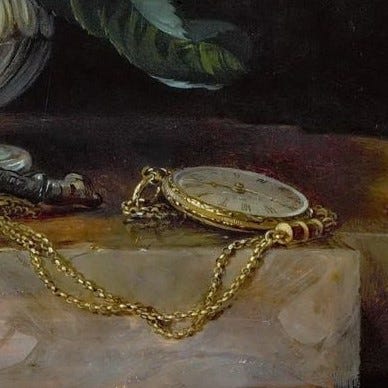 |
| Art by Cornelis de Heem |
In our tiny lifetimes when compared to the scale of history, we as a species have created order out of zilch and erected societies, into which we are born today. Capitalist or not, one must agree that at the heart of all this progress, lies money.
To deepen this discussion, I shall introduce a friend of mine from another world. Meet Lyra. A celestial entity who lives in solitude through the darkness of space. She knows no concept of death.
 |
| Art by Alison Van Pelt |
“Well, what is money?” She asks.
I can bet the first image that comes to your mind is either of coins and paper notes or materialistic objects you’d love to possess.
You think for a while and tell her, “My kind works in groups and money gives one the ability to modify and thrive in their scope of life, in a way that they choose. To create their own niche in the systems and cogs of society.”
Lyra stares absentmindedly as your words go over her head. “Being alive is in itself an act of owning a niche corner of your world which you control solely, what does money have anything to do with it?”
You quickly realise that perhaps the idea of ‘Why society?’ must be understood thoroughly before you step into the topic of money.
Man is a social being and relies heavily on others of his kind to thrive. We build on the knowledge and discoveries of each other and work towards an undefined goal of betterment of life.
“Why, that is fascinating!” she says.
But as fascinating as that is, the ability to create and make something of order, against nature’s entropy comes with a cost. “Aha!” You say. I have found the perfect explanation.
Money can be thought of as a tool to procure human resourcefulness and labour. The power to move, create and change things in our world. With money, we assign the worth of energy and effort spent towards achieving a goal and its product.
Intrigued, she asks, “How then, do you get this.. money? ”
By ‘working?’ It’s just a complicated barter system in a way. You spend your energy and prove your resourcefulness to others. And in return, you gain a pure and tangible measure of your influence which you may spend as you please.
“I think I understand now," she says. “You spend energy to make life comfortable. And money is merely a mediator of that process... A way of quantifying it.”
Indeed. Now we’re getting close to the crux of this discussion. It’s a constant balancing act between time and money for members of my kind. There are few who spend entire lifetimes in pursuit of more and more of it. To most of us, it is only a means to sustenance. The scope of its influence does not exceed ourselves and our immediate surroundings. However, mere sustenance must not be looked down upon. In a world without society, the purpose of money would be meaningless beyond this point.
Those who find contentment with the bare requirements of life, thrive in silence. But alas, we are not all saints and nor is our world a hedonistic one.
Fundamentally, we all seek to assert our control over a wider domain. We seek to be mini demigods of our world and mindlessly pursue money to achieve such a status.
Every act of gaining or purchasing boils down to time and energy. Saving money puts you in a better spot of getting what you want. But the paradox is, when you do get what you want, you are losing money. So do you simply not get anything at all?
“It isn’t so fascinating anymore.. Must be torturous to be caught in this Sisyphean balancing act.” she says, to which you agree.
Many of us blindly chase money while burning through the limited time given to them. Survival of the fittest has been the way of nature, and so we give ourselves the purpose of thriving and becoming the ‘fittest’ in the context of society. Now, I remind you to look at your clock. (If you haven’t thrown it out the window yet.)
It’s been a few minutes since the start of our discussion and the second’s hand continues to trace the hypnotic circle of time. Each passing second, you are older than you have ever been before.
The lilac hue encircling your celestial friend grows brighter as she prepares to depart. “This has been a fruitful conversation my friend. So what do you think is the right way to live?” Lyra asks.
“Ha!” you say, chuckling. “Perhaps the world’s only a large circus. And all we can do is to perfect this balancing act on a tightrope.”
So find your unique place in the world and prove your worth. Earn money. But not to take it to your grave. Earn it to make the memories you want to see yourself making, for they are the only things that will outlast us. Nothing else shall prove to be a worthier reply to the mockery of time eternal.
 |
| Art by Y. Wang |
Comments
Post a Comment